
What if the support meant to give you freedom is actually the thing holding you back? Perhaps your current arrangement feels more like an administrative checklist than a personal partnership. You might worry that speaking up will lead to a disruption in your daily care, or you feel trapped by a notice period you don’t quite understand. It’s natural to feel protective of your routine. Confidence slips when the people in your home no longer align with your vision for the future. Knowing how to change NDIS provider shouldn’t feel like a crisis; it is a vital act of autonomy.
Routine becomes difficult when the support meant to sustain you begins to feel like a burden. It is rarely a sudden crisis that prompts a move. Instead, it is often the quiet realisation that your current provider is no longer a good fit. Perhaps communication has faded, or you feel your autonomy is being slowly replaced by their administrative preferences. Understanding how to change NDIS provider starts with acknowledging that your support should feel personal, not clinical. You deserve a partner, such as Elleson Care, who acts as a steady hand in the background of your life, ensuring your dignity remains the priority.
We understand that stability is everything. You deserve a transition that feels structured and safe, not chaotic. This guide will show you how to move toward a more fulfilling support structure without losing the steadying influence of your daily routine. We’ll walk through the practical steps of checking your service agreement, managing notice periods, and ensuring your NDIS plan goals stay on track during the switch.
Key Takeaways
- Recognise the subtle signs that your support routine is no longer serving your independence and learn how to identify your specific notice period.
- Discover the structured five-step process of how to change NDIS provider while ensuring your daily living supports remain steady and uninterrupted.
- Master the professional way to draft a termination notice that prioritises your right to choice and control without causing unnecessary friction.
- Learn the “overlap strategy” for complex home living transitions, ensuring new support workers are integrated into your life before the old agreement ends.
Knowing When and How to Start Your NDIS Transition
Routine becomes difficult when the support meant to sustain you begins to feel like a burden. It is rarely a sudden crisis that prompts a move. Instead, it is often the quiet realisation that your current provider is no longer a good fit. Perhaps communication has faded, or you feel your autonomy is being slowly replaced by their administrative preferences. Understanding how to change NDIS provider starts with acknowledging that your support should feel personal, not clinical. You deserve a partner who acts as a steady hand in the background of your life, ensuring your dignity remains the priority.
Spotting the Red Flags in Your Current Support
Confidence slips when reliability wavers. If your support worker is frequently late or unorganised, the structure of your day begins to crumble. You might feel like your independence is being ‘taken over’ rather than supported, with your personal choices sidelined to suit a provider’s schedule. A fulfilling life requires a provider who listens. When your goals within the National Disability Insurance Scheme (NDIS) are ignored in favour of their convenience, the partnership is no longer serving its purpose. Understanding what genuine person-centered care NDIS delivery looks like can help you identify whether your current provider is truly meeting your needs or simply going through the motions.
Understanding Your Service Agreement Rights
Your service agreement is a roadmap for your rights. Locate the ‘Termination of Agreement’ clause to find your specific notice period; in Australia, this is typically between 14 and 28 days. For those living in Victoria, local advocacy services can provide extra guidance if you feel uneasy about ending a contract. Don’t worry if you cannot find a physical copy of your agreement. Australian Consumer Law still protects your right to exit services that are not meeting the standards you were promised.
Before you send a formal notice, check your NDIS plan budget. It’s essential to determine if you have enough remaining funding to cover the crossover period while your current provider finishes their notice. This prevents any disruption to your daily living supports. A structured transition ensures that while the names on the service booking change, the rhythm of your life stays steady and secure. If you are still evaluating your options, our guide to choosing the best NDIS provider in Melbourne can help you identify the right qualities to look for before committing to a new agreement.
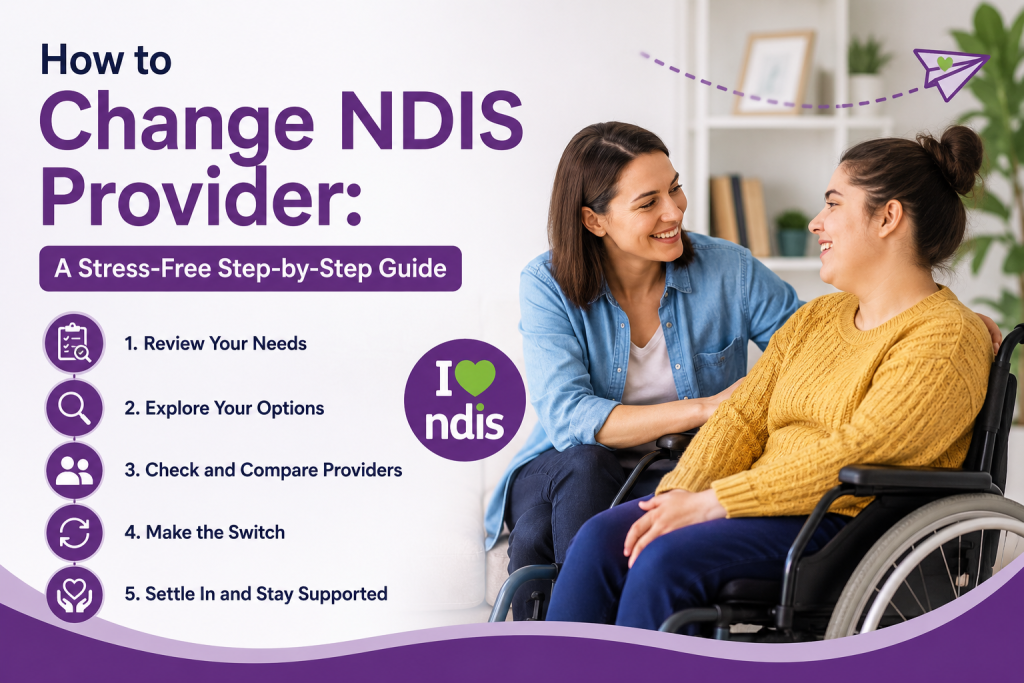
A 5-Step Guide to Changing NDIS Providers Safely
Changing your support structure is a structured process that protects your independence. The focus is simple: you are the director of your own care. When you decide how to change NDIS provider, following a clear sequence ensures no support worker is missed and no funding is stalled. It is about moving from one steady hand to another without the rhythm of your life being disrupted.
Communicating Your Decision to Your Current Provider
Anxiety often stems from the fear of a difficult conversation. You don’t need to justify your personal growth or explain why a service no longer fits your life. A simple, professional statement is enough: “I am exercising my right to choice and control to move to a provider that better fits my current goals.” If you feel uncomfortable, involve a family member or a Victorian-based advocate to sit in on the meeting. This ensures your voice is heard without the pressure of a clinical confrontation. Remember that NDIS providers generally cannot charge exit fees for leaving a service; you are only responsible for the services already delivered during your notice period.
Updating the MyPlace Portal and Service Bookings
Operational reliability is key during the handover. You must ensure your current provider ends their service booking on the MyPlace portal correctly to release your remaining funds. Your Plan Manager can be a steadying influence here, helping to reconcile final invoices and ensuring the new provider can commence their booking without delay. It’s a structured transition that prevents any gap in your assistance with daily life.
Understanding how to change NDIS provider safely also means managing your information. Gather your current care plans, risk assessments, and specialised documents that help your new team understand your routine. Review your new service agreement against the 2025-26 Pricing Arrangements to ensure the rates and terms are transparent. This is your opportunity to reset. A new agreement should feel like a fresh start, aligned with your 2026 goals for independence and community participation. When reviewing a new provider, look beyond the brochure and assess whether their approach to person-centered care NDIS families in Melbourne rely on is genuine rather than simply a marketing promise.

Ensuring a Smooth Move for SIL and SDA Services
Housing is the foundation of independence. It is where your life happens. When your support is tied to where you live, the stakes are naturally higher. Learning how to change NDIS provider for accommodation services requires a more structured approach than simple community access. It isn’t just about an administrative shift; it is about ensuring the sanctity of your home remains untouched. Whether you are looking for Supported Independent Living Melbourne or specialised SDA, the transition must be handled with quiet confidence.
We recommend an ‘overlap’ strategy for complex needs. This involves introducing new support workers while the previous team is still finishing their notice period. It allows for a gentle handover of knowledge. Routine stays steady. The background logistics are managed without forcing you to repeat your story a dozen times. This is especially vital for participants with high physical needs or complex psychosocial disabilities where continuity of care is a non-negotiable requirement for safety.
Specific Considerations for Housing and SIL
You must ensure your budget is ready for the move. Reviewing using NDIS funding for accommodation helps clarify how your SIL or SDA funds will transfer to a new partner. Personality fit is everything. We suggest a ‘Meet and Greet’ with your potential new team to ensure their approach mirrors your values. Understanding how to change NDIS provider in a housing context means prioritising the human connection over the paperwork. To ensure you are selecting a partner with the right credentials and values, reviewing what separates a quality NDIS provider Melbourne families trust can sharpen your decision-making before you sign a new agreement.
The WithCare Approach: A Steady Hand in Transition
Our focus is simple. We prioritise your dignity and autonomy during the first 30 days of service. This period is for listening and observing, not for taking over. We manage the background details, from service bookings to care plan updates, so you can focus on a fulfilling life. Transitioning should feel organised, never clinical. It is a partnership built on respect for your self-directed life, providing a reliable presence that remains unobtrusive yet deeply supportive.
Embracing Your Right to a Fulfilling Support Routine
Your journey with the NDIS should always feel like a path toward greater independence, not a struggle against administrative friction. We have explored how identifying the quiet signs of a mismatch is the first step toward reclaiming your autonomy. By following a structured process, from reviewing notice periods to managing the overlap strategy in SIL homes, you can ensure your daily routine remains steady. Knowing how to change NDIS provider is about more than paperwork. It is about choosing a partner who respects your boundaries and listens to your goals.
At WithCare Support Services, we act as a steady hand in the background of your life. As a Melbourne-based registered NDIS provider, we specialise in person-first SIL and SDA transitions that prioritise your dignity. We manage the complex logistics so you don’t have to, ensuring your care feels organised but never clinical. Ready for a more personal approach? Contact WithCare to discuss a stress-free transition today.
The right support is out there. It is waiting to help you lead a self-directed and fulfilling life. You have the choice, the control, and the right to a partnership that truly works for you.
Frequently Asked Questions
Do I need to tell my current NDIS provider why I am leaving?
No, you are not legally required to provide a specific reason for ending your service. The NDIS is built on the principles of choice and control, meaning you can move to a new partner whenever you feel your personal goals are no longer being met. Keeping the conversation professional and focused on your right to choose ensures a smoother exit. You can simply state that you are moving to a service that better fits your current lifestyle.
What is the standard notice period for NDIS service providers in Australia?
Notice periods are determined by your individual service agreement, but they typically range from 14 to 28 days in Australia. Some complex housing agreements, such as those for Specialist Disability Accommodation (SDA), may require a longer period of up to 90 days. It is essential to check the ‘Termination’ clause in your contract to confirm your specific requirements. If you don’t have a written agreement, a notice period of 14 days is generally considered standard practice.
Can my current provider stop me from leaving if I have a contract?
No provider can legally prevent you from leaving, as the NDIS framework ensures your right to change supports at any time. While you must honour the notice period outlined in your agreement, you are free to move once that period concludes. If a provider attempts to block your transition or charges unauthorised exit fees, you can contact the NDIS Quality and Safeguards Commission. Your independence is protected by Australian Consumer Law and NDIS regulations.
How do I ensure there is no gap in my support during the changeover?
The best way to avoid a gap is to coordinate the start date of your new service with the final day of your old notice period. When learning how to change NDIS provider, we recommend establishing your new service booking before the old one expires. This ensures that your assistance with daily life remains steady. Your Plan Manager can also help by ensuring funds are released promptly, allowing your new team to step in without any missed support.